
[ad_1]
A strand of hair. A poo sample.
These are the kinds of things experts need to be able to definitively confirm whether there’s any possibility the Tasmanian tiger is still alive.
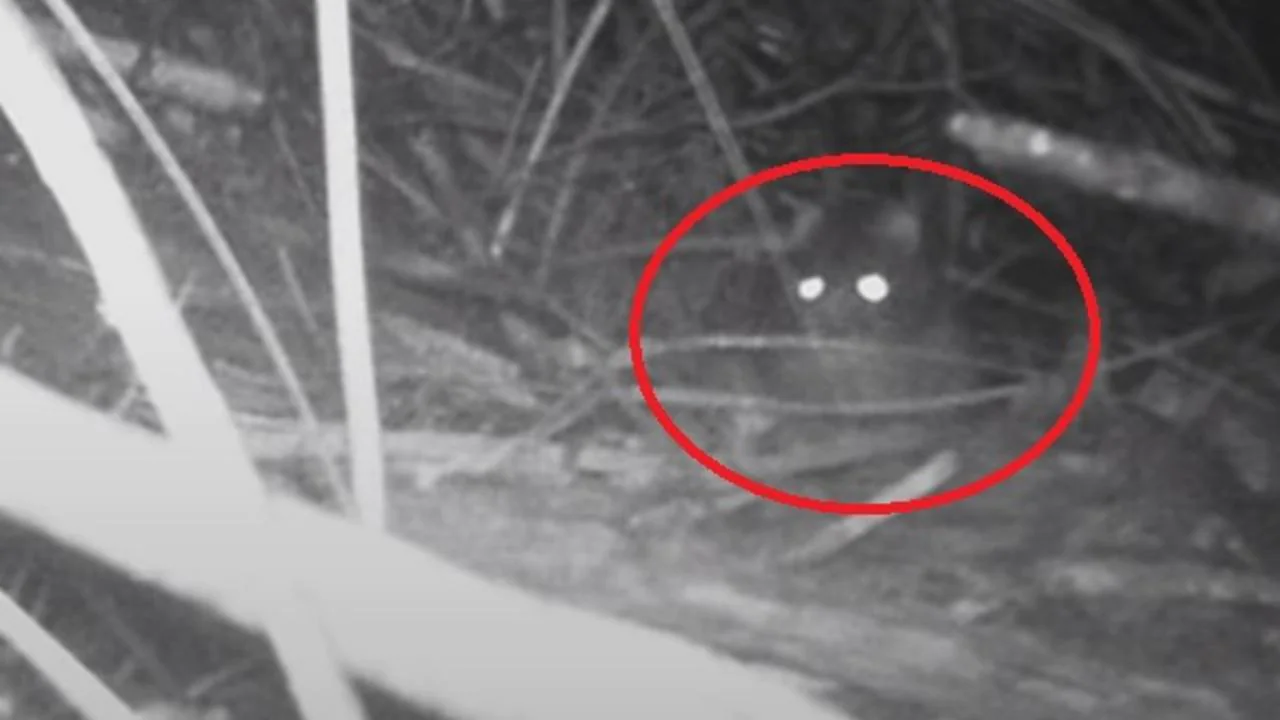
Photos of some unusual looking animals captured in northern Tasmania bushland have got tongues wagging across the world, with the hunter who took them “absolutely confident” one is a thylacine joey.
Even expert opinions that one of the “least ambiguous” images – captured by president of the Thylacine Awareness Group of Australia Neil Waters – are likely of a pademelon joey weren’t enough to convince him.
The South Australian thylacine enthusiast interviewed all kinds of experts for his video release of the highly-anticipated photos he teased a week earlier.
RELATED: ‘Proof’ Tasmanian tiger still exists
Dog and cat experts ruled them out as options, with one vet even saying there was a 70 to 80 per cent chance Mr Waters had snapped a Tasmanian tiger.
News.com.au readers weren’t convinced on the cat ruling, with more than 60 per cent voting the main image was of a cat or kitten, among 14,500 votes.
Mostly people across the world were underwhelmed, hoping the images would be clearer and give them hope the extinct Australian animal was secretly living hidden in bushland.
But even if there was any clearer photo or video evidence, scientists say it still won’t be enough to prove they’re alive.
“Nobody can adequately look at a video and say that’s definitely a thylacine, without some DNA evidence,” Andrew Pask, a marsupial evolutionary biologist at the University of Melbourne, told CNET.
RELATED: Unearthed footage shows last-known glimpse of extinct Tasmanian tiger
“We’ve got to have a hair sample, a scat sample, something that can back it up.
“Given that the thylacine has not been seen for 85 years, the likelihood it is something else is by far the most logical conclusion. It could easily be a cat, dog or wallaby based on the images.”
The time since the last sighting isn’t enough to convince some people – pointing to the mysterious night parrot, one of the most elusive birds in the world.
First recorded in 1845, the last living specimen was collected in Western Australia in 1912. It then disappeared, with no confirmed records of the bird between 1912 and 1979.
In 2013 naturalist and wildlife photographer John Young captured several photos and a few seconds of video footage of a live bird in western Queensland.
Nick Mooney, Honorary Curator of Vertebrate Zoology at the Tasmanian Museum and Art Gallery, did a six-page assessment of the four photos in Mr Waters’ video.
He said the apparent stripes were more “a combination of narrow shadows (from sticks and cutting grass) and natural parts in the fur”.
Mooney suggested pademelons based on animal colour, lack of bands, body shape and some foot detail.
“If these were videos not stills there would have been no question,” he said.
[ad_2]
Source link