
[ad_1]
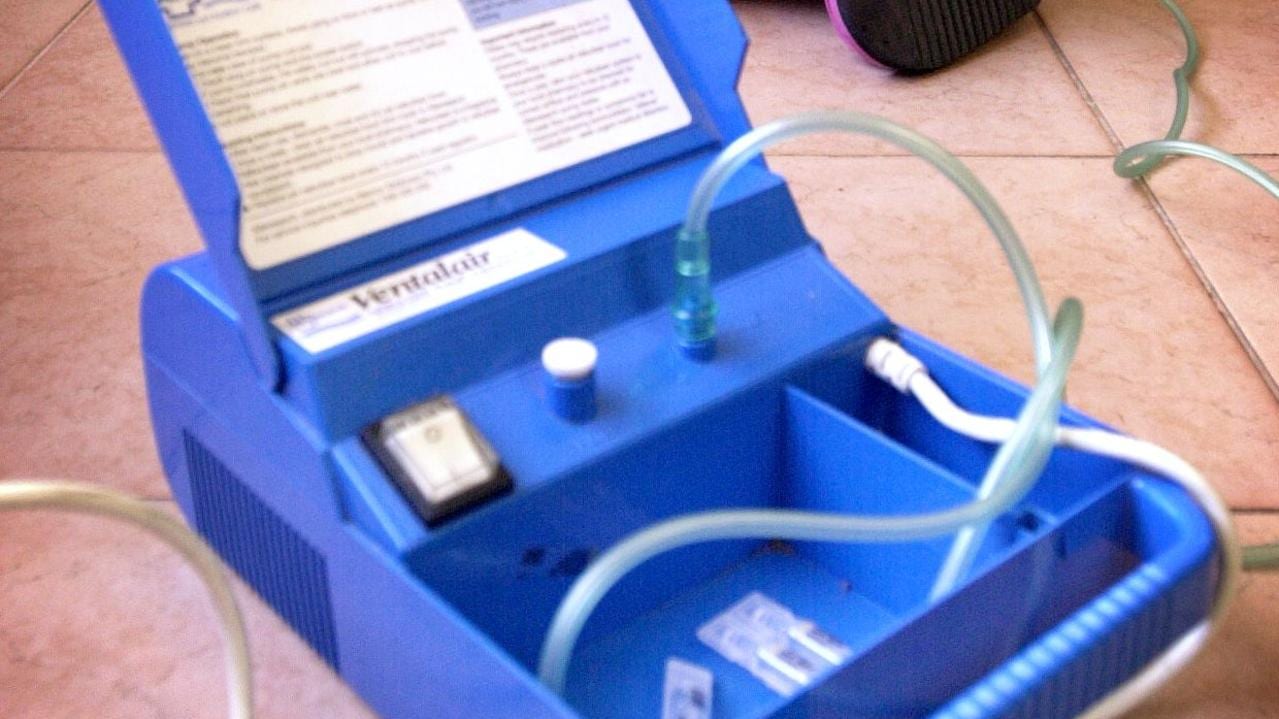
The medical device believed to be behind the spread of COVID-19 in Victorian hotel quarantine is most commonly used to inhale medications to treat lung conditions such as asthma.
A nebuliser has been revealed as the probably cause of the spread of coronavirus at the Melbourne Airport Holiday Inn quarantine hotel.
The working theory of health officials is the food and beverage worker, authorised officer and a resident who has since left hotel quarantine became infected when a quarantine guest with the virus used a nebuliser for medical treatment.
That caused fine aerosolised particles carrying coronavirus to be suspended in the air and spread throughout the hotel.
“If the door of the room is opened for getting a meal that aerosolised virus sitting in the air can move out into the corridor,” chief health officer Brett Sutton said.
Nebulisers are used to convert a liquid solution of a drug into a fine spray or vapour which is then breathed in, according to the British Lung Foundation.
“Nebulisers use oxygen, compressed air or ultrasonic power to break up the liquid drug to deliver the dose you need.”
People with lung conditions use nebulisers to inhale medications to clear their airways, relieve symptoms and prevent flare-ups.
Inhaled medications can help relieve wheezing, breathlessness, chest tightness and help control the build up of phlegm and mucus.
A paper published by the Australian Commission on Safety and Quality in Health Care in May 2020 said nebulisers were “not recommended” in patients with COVID-19 as it may “contribute to the spread of the virus”.
“Nebulisers disperse infectious virus particles often metres around and can rapidly spread
infection from respiratory viruses, such as influenza and SARS-CoV-2,” they said.
“The risk of infection transmission via aerosols may increase during nebulisation due to the potential to generate a high volume of respiratory aerosols that may be propelled over a longer distance than occurs with natural dispersion.”
The commission urged patients to use puffers or spacers over a nebuliser.
Monash University senior lecturer Daniel Duke, who specialises in droplets, aerosols and inhaled drug delivery devices research, said nebulisers were purposefully designed to produce thousands of times more aerosol than natural breathing.
He said the best available science showed coronavirus was capable of spreading by aerosol transmission.
“When someone inhales a nebuliser mist, it goes into their lungs and then they breathe a lot of it back out again,” Dr Duke said.
“That’s why you breathe it through a mask or spacer device – less gets lost.
“A lot of the aerosol from the nebuliser will naturally escape into the room, far more than would naturally be emitted by normal breathing.
“If they happen to be shedding a lot of virus at the time of use, there might be an increased risk of aerosol spread.
“Nebulisers are used extensively in hospitals and the risk in those settings is carefully managed. The same cannot be said for other environments like hotels.”
Dr Duke said the more aerosol someone exhaled, the higher the risk of transmission.
“Nebulisers increase that aerosol quantity significantly,” he said.
“This is a real cause for concern and more research is urgently needed.”
The Holiday Inn outbreak has now infected 10 people – a family of three, two other returned travellers who were quarantining and a food and beverage worker, authorised officer and another worker based at the hotel.
The final two infections were announced on Thursday afternoon and are household contacts of one of the workers who previously tested positive.
Any worker or resident who spent 15 minutes or more at the Holiday Inn between January 27 and February 9 has been considered a close contact and must isolate for 14 days.
[ad_2]
Source link